Virtual Reality in Adaptive Learning: Identifying Learning Styles and Integration in Educational Apps
DOI:
https://doi.org/10.51903/jtie.v4i2.268Keywords:
Virtual Reality, Emotion Driven Learning, Artificial Intelligence, Cognitive Load, Personalized EducationAbstract
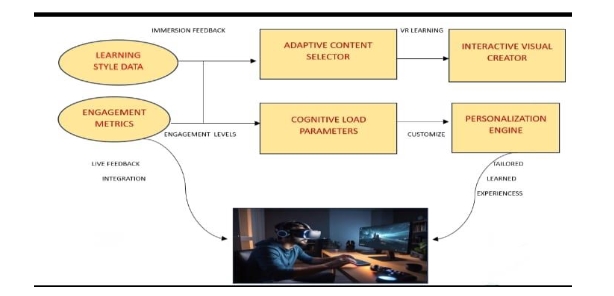
The increasing demand for personalized education in digital environments has highlighted the limitations of traditional, static learning methods. This study addresses the challenge of accommodating diverse learning preferences and emotional responses by leveraging Virtual Reality (VR) to create immersive, adaptive learning systems. The research focuses on designing a VR-based educational framework that integrates artificial intelligence to personalize instruction, monitor emotional states, and support ethical assessment. A primary goal is to identify how students' learning styles and emotional conditions influence their experience in VR, and how educational systems can adapt in real time to these factors. Key components of the proposed system include customizable AI tutors that resemble familiar figures to boost learner motivation, real-time emotion detection during virtual exams, and cognitive load management through adaptive content delivery. Methods involve tracking emotions through facial analysis, monitoring gaze, and providing physiological feedback to dynamically adjust test environments. The findings suggest that while VR enhances engagement and satisfaction, excessive sensory input can lead to cognitive strain, underscoring the importance of balanced immersion. The study contributes a novel, emotion-driven VR framework that combines personalization, gamification, and ethical monitoring. This integrated approach provides a foundation for inclusive, engaging, and effective virtual learning systems that align with individual learner needs and support academic integrity.
References
Asad, M. M., & Hussain, A. (2021). Virtual Reality as a Pedagogical Tool to Enhance Experiential Learning: A Systematic Literature Review. Education Research International, 2021, 1–13. https://doi.org/10.1155/2021/7061623
Badrinarayanan, P., & Kapur, R. (2023). Gaze-Based Learning Interactions in Immersive Learning. Journal of Educational Technology & Society, 26(1), 12–25.
Broetje, J., & Van Ginkel, S. (2021). Personalizing Feedback in Immersive VR: Impacts on Oral Presentation Skills. Computers & Education, 173, 104290. https://doi.org/10.1016/j.compedu.2021.104290
Chen, L., Sun, D. W., & Zhao, Y. (2021). Non-Destructive Detection of Food Contamination Using Hyperspectral Imaging. Journal of Food Engineering, 285, 110139. https://doi.org/10.1016/j.jfoodeng.2020.110139
Chiossi, F., Ou, C., Gerhardt, C., Putze, F., & Mayer, S. (2023). Designing and Evaluating an Adaptive Virtual Reality System Using EEG Frequencies. arXiv Preprint arXiv:2311.10447. https://arxiv.org/abs/2311.10447
Daza, R., Shengkai, L., Morales, A., Fierrez, J., & Nagao, K. (2025). SMARTe-VR: Student Monitoring and Adaptive Response Technology for E-Learning in VR. arXiv Preprint arXiv:2501.10977. https://arxiv.org/abs/2501.10977
Falah, J., Wedyan, M., Alfalah, S. F. M., Abu-Tarboush, M., Al-Jakheem, A., Al-Faraneh, M., Abuhammad, A., & Charissis, V. (2021). Identifying the Characteristics of Virtual Reality Gamification for Complex Educational Topics. Multimodal Technologies and Interaction, 5(53). https://doi.org/10.3390/mti5090053
Gao, F., & Doll, B. (2023). Virtual Agents and Emotional Adaptability in Education. Computers in Education Journal, 33(4), 82–94.
Garcia, L. M., & Torres, R. A. (2021). Adaptive Learning Systems in VR: A Review. Computers in Human Behavior, 115, 106610. https://doi.org/10.1016/j.chb.2020.106610
Huang, C. L., Luo, Y. F., Yang, S. C., Lu, C. M., & Chen, A. S. (2019). Influence of Students’ Learning Style, Sense of Presence, and Cognitive Load on Learning Outcomes in an Immersive Virtual Reality Learning Environment. Journal of Educational Computing Research, 58(3), 596–615. https://doi.org/10.1177/0735633119867422
Kumar, S., & Patel, D. (2024). Virtual Reality in Medical Education: A Review. Medical Education Online, 29(1), 2045678. https://doi.org/10.1080/10872981.2024.2045678
Liu, L. (2025). Enhancing Educational Outcomes Through Hybrid VR/AR Environments. E-Learning and Digital Media, 22(1), 1–20. https://doi.org/10.1177/14727978241312994
Lui, L. F., Radhakrishnan, U., Chinello, F., & Koumaditis, K. (2025). The Efficacy of Adaptive Training in Immersive Virtual Reality for a Fine Motor Skill Task. Virtual Reality, 29(20). https://doi.org/10.1007/s10055-024-01083-z
Madden, M., McDermott, E., & Arshad, U. (2022). Solar System Simulation in VR for Middle Schoolers. Education and Information Technologies, 27, 2439–2457. https://doi.org/10.1007/s10639-021-10778-z
Marougkas, A., Troussas, C., Krouska, A., & Sgouropoulou, C. (2023). How Personalized and Effective Is Immersive Virtual Reality in Education? A Systematic Literature Review for the Last Decade. Multimedia Tools and Applications, 83, 18185–18233. https://doi.org/10.1007/s11042-023-15986-7
Nasri, M. (2025). Towards Intelligent VR Training: A Physiological Adaptation Framework. arXiv Preprint arXiv:2504.06461. https://arxiv.org/abs/2504.06461
Nguyen, T. T., & Chen, M. Y. (2023). Emotion Recognition in Virtual Learning Environments Using Deep Learning. IEEE Transactions on Learning Technologies, 16(2), 234–245. https://doi.org/10.1109/tlt.2022.3145678
Pande, M., & Johnson, R. (2022). AI-Assisted VR Tutors: Increasing Inclusivity in STEM Education. Interactive Learning Environments. https://doi.org/10.1080/10494820.2022.2086435
Philippe, S., Souchet, A. D., Lameras, P., Petridis, P., Caporal, J., Coldeboeuf, G., & Duzan, H. (2020). Multimodal Teaching, Learning, and Training in Virtual Reality: A Review and Case Study. Virtual Reality & Intelligent Hardware, 2(5), 421–442. https://doi.org/10.1016/j.vrih.2020.07.008
Pirker, J., & Dengel, A. (2023). Designing VR Environments for Personalized Exploration and Feedback. British Journal of Educational Technology, 54(1), 98–116. https://doi.org/10.1111/bjet.13262
Porter, L., & Hannafin, M. (2023). Electric Field Exploration in VR-Enhanced Physics Education. Journal of Science Education and Technology, 32(3), 501–519. https://doi.org/10.1007/s10956-023-10005-w
Ramaseri-Chandra, A. N., & Reza, H. (2025). Dynamic Cybersickness Mitigation via Adaptive FFR and FoV Adjustments. arXiv Preprint arXiv:2502.03419. https://arxiv.org/abs/2502.03419
Rao, S., & Li, T. (2021). Movement-Based Interaction and Engagement in VR Learning. Journal of Computer Assisted Learning, 37(2), 402–418. https://doi.org/10.1111/jcal.124
Sharma, V., Singh, R., & Gupta, N. (2020). Application of Convolutional Neural Networks for Hyperspectral Imaging in Milk Adulteration Detection. Indian Journal of Dairy Science, 73(4), 255–262.
Shomoye, M. A. (2024). Exploring Emotion Recognition of Students in Virtual Reality Classrooms Through Convolutional Neural Networks and Transfer Learning Techniques (Master's thesis, University of Calgary, Calgary, Canada). PRISM Repository. https://hdl.handle.net/1880/117972
Smith, A. J., & Lee, B. K. (2022). Gamification in VR: Enhancing Student Engagement. Journal of Educational Computing Research, 60(5), 1234–1250. https://doi.org/10.1177/07356331211045678
Zhang, Y., & Wang, H. (2022). The Impact of Immersive Virtual Reality on Language Learning: A Meta-Analysis. Educational Research Review, 35, 100451. https://doi.org/10.1016/j.edurev.2021.100451
Downloads
Published
Issue
Section
License
Copyright (c) 2025 P. Divyadharshini, R. Princi, G. Subashini, B. Moohambgai

This work is licensed under a Creative Commons Attribution-ShareAlike 4.0 International License.