Smart Healthcare: Harnessing AI for Early prediction of Neurodegenerative disease
DOI:
https://doi.org/10.51903/jtie.v4i2.269Keywords:
Artificial Intelligence (AI), Early Diagnosis, Health Monitoring System, Neurodegenerative Diseases, Wearable TechnologyAbstract
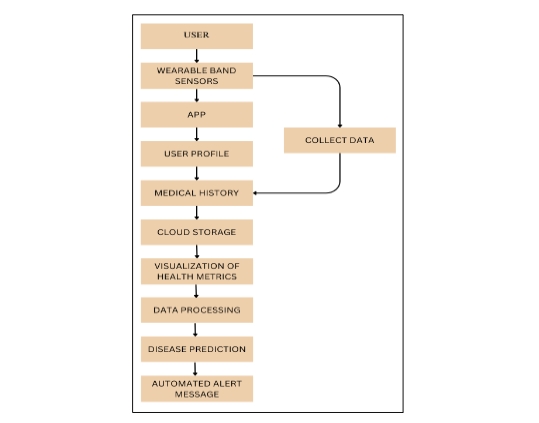
Neurodegenerative disorders such as Parkinson’s disease, Alzheimer’s disease, and Amyotrophic Lateral Sclerosis (ALS) are progressive conditions that result in the deterioration of neuronal function. Early diagnosis remains a significant challenge due to the subtle onset of symptoms and the lack of accessible diagnostic tools, particularly in low-resource settings. These challenges often lead to delayed interventions and poor patient outcomes. This research proposes an innovative healthcare solution for the early prediction and monitoring of neurodegenerative diseases, utilizing artificial intelligence (AI) and wearable technology. The proposed system integrates an AI-powered mobile application that analyzes patient medical history using secure Aadhaar-based authentication. The model utilizes Recurrent Neural Networks (RNNs) and transfer learning to detect early-stage neurodegeneration. Although the system is currently in a conceptual stage, preliminary testing was performed using simulated patient data to verify workflow functionality. The complete model is designed to be evaluated using benchmark datasets, such as ADNI and MIMIC-III, with metrics including accuracy, F1-score, and ROC-AUC. The wearable device continuously monitors vital signs and provides real-time alerts for patients and guardians. This comprehensive framework addresses gaps in early diagnosis, enhances accessibility, and supports proactive care for underserved communities.
References
Badawy, M., & Haikal, A. Y. (2022). Deep Learning Approach for Early Detection of Alzheimer’s Disease. Cognitive Computation, 14(4), 1711–1727. https://doi.org/10.1007/s12559-021-09946-2
Birenbaum, D., Bancroft, L. W., & Felsberg, G. J. (2011). Imaging in Acute Stroke. Western Journal of Emergency Medicine, 12(1), 67–76. https://www.ncbi.nlm.nih.gov/pmc/articles/PMC3088377
Cullen, A., Mazhar, M. K. A., Smith, M. D., Lithander, F. E., Ó Breasail, M., & Henderson, E. J. (2022). Wearable and Portable GPS Solutions for Monitoring Mobility in Dementia: A Systematic Review. Sensors, 22(9), 3336. https://doi.org/10.3390/s22093336
Demrozi, F., Borzì, L., & Olmo, G. (2023). Wearable Sensors for Supporting Diagnosis, Prognosis, and Monitoring of Neurodegenerative Diseases. Electronics, 12(6), 1269. https://doi.org/10.3390/electronics12061269
Fabrizio, C., Termine, A., Caltagirone, C., & Sancesario, G. (2021). Artificial Intelligence for Alzheimer’s Disease: Promise or Challenge? Diagnostics, 11(8), 1473. https://doi.org/10.3390/diagnostics11081473
Frizzell, T. O., Glashutter, M., Liu, C. C., Zeng, A., Pan, D., Hajra, S. G., D’Arcy, R. C. N., & Song, X. (2022). Artificial Intelligence in Brain MRI Analysis of Alzheimer’s Disease Over the Past 12 Years: A Systematic Review. Ageing Research Reviews, 77, 101614. https://doi.org/10.1016/j.arr.2022.101614
Ganjizadeh, A., Wei, Y., & Erickson, B. J. (2024). From Pixels to Prognosis: AI-Driven Insights Into Neurodegenerative Diseases. Medical Research Archives, 12(6). https://doi.org/10.18103/mra.v12i6.5512
Hampel, H., et al. (2018). Blood-Based Biomarkers for Alzheimer’s Disease: Mapping the Road to the Clinic. Nature Reviews Neurology, 14(11), 639–652. https://doi.org/10.1038/s41582-018-0079-7
Hillis, J. M., Scheffer Cliff, E. R., & Vokinger, K. N. (2025). AI Devices in Neurology—Moving From Diagnosis to Prognosis. JAMA Neurology, 82(2), 117–118. https://doi.org/10.1001/jamaneurol.2024.3835
Islam, J., & Zhang, Y. (2018). Brain MRI Analysis for Alzheimer's Disease Diagnosis Using an Ensemble System of Deep Convolutional Neural Networks. Brain Informatics, 5(2), 2. https://doi.org/10.1186/s40708-018-0080-3
Johnson, K. B., Wei, W. Q., Weeraratne, D., et al. (2021). Precision Medicine, AI, and the Future of Personalized Health Care. Clinical and Translational Science, 14(1), 86–93. https://doi.org/10.1111/cts.12884
Jones, D. T., & Kerber, K. A. (2022). Artificial Intelligence and the Practice of Neurology in 2035. Neurology, 98(6), 269–275. https://doi.org/10.1212/wnl.0000000000013200
Kalani, M., & Anjankar, A. (2024). Revolutionizing Neurology: The Role of Artificial Intelligence in Advancing Diagnosis and Treatment. Cureus, 16(6), e61706. https://doi.org/10.7759/cureus.61706
Kaunzner, U. W., & Gauthier, S. A. (2017). MRI in the Assessment and Monitoring of Multiple Sclerosis: An Update on Best Practice. Therapeutic Advances in Neurological Disorders, 10(4), 247–261. https://doi.org/10.1177/1756285617708911
McKeith, I. G., et al. (2017). Diagnosis and Management of Dementia With Lewy Bodies: Fourth Consensus Report. Neurology, 89(1), 88–100. https://doi.org/10.1212/wnl.0000000000004058
Modi, K., & Devara, L. (n.d.). Advancements in Biometric Technology With Artificial Intelligence. [Preprint]. https://doi.org/10.13140/rg.2.2.25587.20007
Myszczynska, M. A., Ojamies, P. N., Lacoste, A. M. B., Neil, D., Saffari, A., Mead, R., Hautbergue, G. M., Holbrook, J. D., & Ferraiuolo, L. (2020). Applications of Machine Learning to Diagnosis and Treatment of Neurodegenerative Diseases. Nature Reviews Neurology, 16(8), 440–456. https://doi.org/10.1038/s41582-020-0377-8
Navar, I. (2025, March). I Started a Nonprofit to Fight ALS After My Husband's Death. Here's How Tech and AI Can Help Us Find a Cure. Business Insider. https://www.businessinsider.com/indu-navar-nonprofit-everything-als-ai-tech-silicon-valley-2025-3
NeurEye Research Team. (2025, January). Early Signs of Dementia Could Be Spotted Through Your Eyes With New AI Tool. New York Post. https://nypost.com/2025/01/21/health/early-signs-of-dementia-could-be-found-in-eyes-with-new-ai-tool/
New AI Tool Predicts Brain Decline Years Before Symptoms Appear—How It Could Help Fight Dementia. (2025, March). New York Post. https://nypost.com/2025/03/08/health/new-ai-tool-predicts-brain-decline-before-symptoms-appear/
Postuma, R. B., et al. (2015). MDS Clinical Diagnostic Criteria for Parkinson’s Disease. Movement Disorders, 30(12), 1591–1601. https://doi.org/10.1002/mds.26424
Ren, L., & Peng, Y. (2019). Research of Fall Detection and Fall Prevention Technologies: A Systematic Review. IEEE Access. https://doi.org/10.1109/access.2019.2922708
Senatore, R., Della Cioppa, A., & Marcelli, A. (2019). Automatic Diagnosis of Neurodegenerative Diseases: An Evolutionary Approach for Facing the Interpretability Problem. Information, 10(1), 30. https://doi.org/10.3390/info10010030
Shimizu, S., Hirose, D., Hatanaka, H., et al. (2018). Role of Neuroimaging as a Biomarker for Neurodegenerative Diseases. Frontiers in Neurology, 9, 265. https://doi.org/10.3389/fneur.2018.00265
Ten-Minute Brain Scan Could Detect Dementia Early, Study Suggests. (2024, June). The Guardian. https://www.theguardian.com/society/article/2024/jun/06/ten-minute-brain-scan-could-detect-dementia-early-study-suggests
Wearable Sensors and Features for Diagnosis of Neurodegenerative Diseases: A Systematic Review. (2023). Frontiers in Aging Neuroscience. https://doi.org/10.3389/fnagi.2023.10192816
Xie, H., Wang, Y., Tao, S., Huang, S., Zhang, C., & Lv, Z. (2019). Wearable Sensor-Based Daily Life Walking Assessment of Gait for Distinguishing Individuals With Amnestic Mild Cognitive Impairment. Frontiers in Aging Neuroscience, 11, 285. https://doi.org/10.3389/fnagi.2019.00285
Yang, Y., Yuan, Y., Zhang, G., Wang, H., Chen, Y.-C., Liu, Y., Tarolli, C. G., Crepeau, D., Bukartyk, J., Junna, M. R., et al. (2022). Artificial Intelligence-Enabled Detection and Assessment of Parkinson’s Disease Using Nocturnal Breathing Signals. Nature Medicine, 28, 2207–2215. https://doi.org/10.1038/s41591-022-01927-4
Downloads
Published
Issue
Section
License
Copyright (c) 2025 M. Harrisha, J. Monikasree, J. Swathi, D. Karthika

This work is licensed under a Creative Commons Attribution-ShareAlike 4.0 International License.