Optimization of Inclusive Education Through the Implementation of Artificial Intelligence: Opportunities and Challenges
DOI:
https://doi.org/10.51903/jtie.v4i2.219Keywords:
Artificial Intelligence, Inclusive Education, Personalized Learning, Educational Technology, Challenges and OpportunitiesAbstract
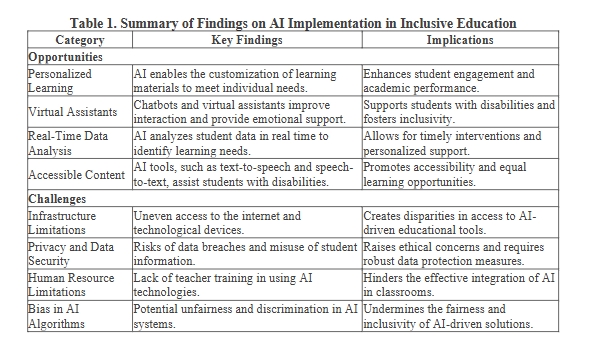
Inclusive education is critical to ensuring equitable learning opportunities for all students, regardless of their abilities or backgrounds. This study aims to analyze the optimization of inclusive education by implementing artificial intelligence (AI), focusing on identifying the opportunities and challenges that arise. A systematic literature review was conducted as the research method, referencing five journals related to the application of AI in education and other relevant sectors. The findings reveal that AI has significant potential to enhance the quality of inclusive education by enabling personalized learning materials, real-time student data analysis, and improved teacher-student interactions. These advancements can help address diverse learning needs and promote a more inclusive learning environment. However, several challenges must be addressed, including technological disparities, limited infrastructure, and ethical concerns related to AI usage, such as data privacy and algorithmic bias. The study concludes that the successful implementation of AI in inclusive education requires collaborative efforts among governments, educational institutions, and other stakeholders to ensure accessibility, equity, and sustainability. Key recommendations include the development of supportive policies, enhancement of digital literacy among educators and students, and investment in technological infrastructure to bridge the digital divide. This research contributes to the growing discourse on the integration of AI in education, providing insights for policymakers and practitioners aiming to harness AI's potential for inclusive education.
References
Adel, A. (2024). The Convergence of Intelligent Tutoring, Robotics, and IoT in Smart Education for the Transition from Industry 4.0 to 5.0. Smart Cities, 7(1), 325–369. https://doi.org/10.3390/smartcities7010014
Adel, A., Ahsan, A., & Davison, C. (2024). ChatGPT Promises and Challenges in Education: Computational and Ethical Perspectives. Education Sciences, 14(8), 814. https://doi.org/10.3390/educsci14080814
Amponsah, S., & Bekele, T. A. (2023). Exploring Strategies for Including Visually Impaired Students in Online Learning. Education and Information Technologies, 28(8), 9355–9377. https://doi.org/10.1007/s10639-022-11145-x
Barua, P. D., Vicnesh, J., Gururajan, R., Oh, S. L., Palmer, E., Azizan, M. M., Kadri, N. A., & Acharya, U. R. (2022). Artificial Intelligence Enabled Personalised Assistive Tools to Enhance Education of Children with Neurodevelopmental Disorders—A Review. International Journal of Environmental Research and Public Health, 19(3), 1192. https://doi.org/10.3390/ijerph19031192
Bulathwela, S., Pérez-Ortiz, M., Holloway, C., Cukurova, M., & Shawe-Taylor, J. (2024). Artificial Intelligence Alone Will Not Democratise Education: On Educational Inequality, Techno-Solutionism and Inclusive Tools. Sustainability, 16(2), 781. https://doi.org/10.3390/su16020781
Caiza, G., Sanguña, V., Tusa, N., Masaquiza, V., Ortiz, A., & Garcia, M. V. (2024). Navigating Governmental Choices: A Comprehensive Review of Artificial Intelligence’s Impact on Decision-Making. Informatics, 11(3), 64. https://doi.org/10.3390/informatics11030064
Chalkiadakis, A., Seremetaki, A., Kanellou, A., Kallishi, M., Morfopoulou, A., Moraitaki, M., & Mastrokoukou, S. (2024). Impact of Artificial Intelligence and Virtual Reality on Educational Inclusion: A Systematic Review of Technologies Supporting Students with Disabilities. Education Sciences, 14(11), 1223. https://doi.org/10.3390/electronics13183762
George, B., & Wooden, O. (2023). Managing the Strategic Transformation of Higher Education through Artificial Intelligence. Administrative Sciences, 13(9), 196. https://doi.org/10.3390/admsci13090196
Halkiopoulos, C., & Gkintoni, E. (2024). Leveraging AI in E-Learning: Personalized Learning and Adaptive Assessment through Cognitive Neuropsychology—A Systematic Analysis. Electronics, 13(18), 3762. https://doi.org/10.3390/electronics13183762
Jamaludin, H., Achlison, U., & Rokhman, N. (2024). Enhancing AI Model Accuracy and Scalability Through Big Data and Cloud Computing. Journal of Technology Informatics and Engineering, 3(3), 296–307. https://doi.org/10.51903/jtie.v3i3.203
Kamalov, F., Santandreu Calonge, D., & Gurrib, I. (2023). New Era of Artificial Intelligence in Education: Towards a Sustainable Multifaceted Revolution. Sustainability, 15(16), 12451. https://doi.org/10.3390/su151612451
Lin, M., Liu, P.-C. ;, Poitras, A. L. ;, Chang, E. ;, Chang, M. ;, Pin, M., Lin, -Chuan, Liu, A. L., Poitras, E., Chang, M., & Chang, D. H. (2024). An Exploratory Study on the Efficacy and Inclusivity of AI Technologies in Diverse Learning Environments. Sustainability, 16(20), 8992. https://doi.org/10.3390/su16208992
Melo-López, V. A., Basantes-Andrade, A., Gudiño-Mejía, C. B., & Hernández-Martínez, E. (2025). The Impact of Artificial Intelligence on Inclusive Education: A Systematic Review. Education Sciences, 15(5), 539. https://doi.org/10.3390/educsci15050539
Miller, T., Durlik, I., Łobodzińska, A., Dorobczyński, L., & Jasionowski, R. (2024). AI in Context: Harnessing Domain Knowledge for Smarter Machine Learning. Applied Sciences, 14(24), 11612. https://doi.org/10.3390/app142411612
Munir, H., Vogel, B., & Jacobsson, A. (2022). Artificial Intelligence and Machine Learning Approaches in Digital Education: A Systematic Revision. Information, 13(4), 203. https://doi.org/10.3390/info13040203
Olmos-Gómez, C., Luque Suárez, M., Manuel Cuevas Rincón, J., Zobeida Salas-Pilco, S., Xiao, K., & Oshima, J. (2022). Artificial Intelligence and New Technologies in Inclusive Education for Minority Students: A Systematic Review. Sustainability, 14(20), 13572. https://doi.org/10.3390/su142013572
Pagliara, S. M., Bonavolontà, G., Pia, M., Falchi, S., Zurru, A. L., Fenu, G., & Mura, A. (2024). The Integration of Artificial Intelligence in Inclusive Education: A Scoping Review. Information, 15(12), 774. https://doi.org/10.3390/info13040203
Qu, X. (2022). Structural Barriers to Inclusive Education for Children with Special Educational Needs and Disabilities in China. Journal of Educational Change, 23(2), 253–276. https://doi.org/10.1007/s10833-021-09426-2
Soltani, S., Maxwell, D., & Rashidi, A. (2023). The State of Industry 4.0 in the Australian Construction Industry: An Examination of Industry and Academic Point of View. Buildings, 13(9), 2324. https://doi.org/10.3390/buildings13092324
Taufik, M., Aziz, M. S., & Fitriana, A. (2025). Hybrid Explainable AI (XAI) Framework for Detecting Adversarial Attacks in Cyber-Physical Systems. Journal of Technology Informatics and Engineering, 4(1). https://doi.org/10.51903/jtie.v4i1.295
Wang, T., Lund, B. D., Marengo, A., Pagano, A., Mannuru, N. R., Teel, Z. A., & Pange, J. (2023). Exploring the Potential Impact of Artificial Intelligence (AI) on International Students in Higher Education: Generative AI, Chatbots, Analytics, and International Student Success. Applied Sciences, 13(11), 6716. https://doi.org/10.3390/app13116716
Wibowo, M. C., & Santoso, J. T. (2024). Empowering Urban Farmers: An Asynchronous Learning Application for Greenhouse Management. Journal of Technology Informatics and Engineering, 3(2), 138–150. https://doi.org/10.51903/jtie.v3i2.185
Yigitcanlar, T., David, A., Li, W., Fookes, C., Bibri, S. E., & Ye, X. (2024). Unlocking Artificial Intelligence Adoption in Local Governments: Best Practice Lessons from Real-World Implementations. Smart Cities, 7(4), 1576–1625. https://doi.org/10.3390/smartcities7040064
Zickafoose, A., Ilesanmi, O., Diaz-Manrique, M., Adeyemi, A. E., Walumbe, B., Strong, R., Wingenbach, G., Rodriguez, M. T., & Dooley, K. (2024). Barriers and Challenges Affecting Quality Education (Sustainable Development Goal #4) in Sub-Saharan Africa by 2030. Sustainability, 16(7), 2657. https://doi.org/10.3390/su16072657
Zong, Z., & Guan, Y. (2024). AI-Driven Intelligent Data Analytics and Predictive Analysis in Industry 4.0: Transforming Knowledge, Innovation, and Efficiency. Journal of the Knowledge Economy, 16(1), 864–903. https://doi.org/10.1007/s13132-024-02001-z
Downloads
Published
Issue
Section
License
Copyright (c) 2025 Haris Jamaludin, Budi Hartono , Arsito Ari Kuncoro

This work is licensed under a Creative Commons Attribution-ShareAlike 4.0 International License.