Contextual Framework for Remote Intelligent Monitoring and Detection System for Prediction of Pregnancy Complications
DOI:
https://doi.org/10.51903/jtie.v4i2.244Keywords:
P-Health, Webserver API, Supervised Machine Learning Model (SMLM) , Maternal Health Risk (MHR)Abstract
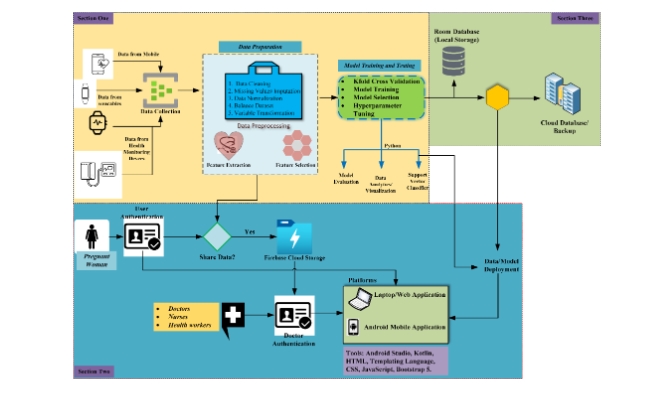
Maternal health disorders can cause complications and harmful incidents in women during pregnancy. To minimize risks, this research developed a platform powered by a supervised machine learning model (SMLM) to support remote intelligent monitoring and prediction of pregnancy complications caused by hypertensive disorder, gestational diabetes, and related indicators. The study used real-world datasets with six UCI Machine Learning Repository features to identify and predict Maternal Health Risk (MHR) factors. A Support Vector Machine (SVM) algorithm was applied to construct the classifier model, which was trained and evaluated using StratifiedKFold cross-validation (k=10). The model achieved 80% accuracy with a precision, recall, and F1-score of 77%. The outcome of this work is the P-Health mobile application, designed to record and track blood pressure, blood sugar, heart rate, body temperature, and weight, while predicting the risk level of pregnancy complications through inference from the integrated machine learning model. Developed with Kotlin and Android Studio, the application enables healthcare practitioners to remotely monitor patients’ vitals in real time. This innovation addresses the challenge of early detection of pregnancy complications and provides continuous monitoring and assessment. The findings suggest that P-Health can improve early detection and timely intervention, helping medical specialists minimize maternal health risks. The system also has the potential to raise public awareness of maternal health issues, thereby contributing to the prevention of complications during pregnancy.
References
Ahmed, M., Kashem, M. A., Rahman, M., & Khatun, S. (2020). Review and Analysis of Risk Factor of Maternal Health in Remote Area Using the Internet of Things (IoT). Lecture Notes in Electrical Engineering, 632, 357–365. https://doi.org/10.1007/978-981-15-2317-5_30
Cerundolo, N., Siniscalchi, C., Okoye, C., Scarlata, S., Parise, A., Rendo, M., Guerra, A., Meschi, T., Nouvenne, A., & Ticinesi, A. (2025). Integrated Lung, Diaphragm and Lower Limb Muscular Ultrasound: Clinical Correlations in Geriatric Patients with Acute Respiratory Illness. Diagnostics, 15(1), 87. https://doi.org/10.3390/diagnostics15010087
Elbatanouny, H., Kleanthous, N., Dahrouj, H., Alusi, S., Almajali, E., Mahmoud, S., & Hussain, A. (2024). Insights into Parkinson’s Disease-Related Freezing of Gait Detection and Prediction Approaches: A Meta Analysis. Sensors, 24(12), 3959. https://doi.org/10.3390/s24123959
Feduniw, S., Golik, D., Kajdy, A., Pruc, M., Modzelewski, J., Sys, D., Kwiatkowski, S., Makomaska-Szaroszyk, E., & Rabijewski, M. (2022). Application of Artificial Intelligence in Screening for Adverse Perinatal Outcomes—A Systematic Review. Healthcare, 10(11), 2164. https://doi.org/10.3390/healthcare10112164
Gómez-Jemes, L., Oprescu, A. M., Chimenea-Toscano, Á., García-Díaz, L., & Romero-Ternero, M. del C. (2022). Machine Learning to Predict Pre-Eclampsia and Intrauterine Growth Restriction in Pregnant Women. Electronics, 11(19), 3240. https://doi.org/10.3390/electronics11193240
Hossain, M. M., Kashem, M. A., Islam, M. M., Sahidullah, M., Mumu, S. H., Uddin, J., Aray, D. G., de la Torre Diez, I., Ashraf, I., & Samad, M. A. (2023). Internet of Things in Pregnancy Care Coordination and Management: A Systematic Review. Sensors, 23(23), 9367. https://doi.org/10.3390/s23239367
Hurt, K. J., Guile, M. W., Bienstock, J. L., Fox, H. E., & Wallach, E. E. (2012). The Johns Hopkins Manual of Gynecology and Obstetrics. Lippincott Williams & Wilkins. https://www.r2library.com/Resource/Title/1605474339
Irfan, N., Zafar, S., & Hussain, I. (2024). Holistic Analysis and Development of a Pregnancy Risk Detection Framework: Unveiling Predictive Insights Beyond Random Forest. SN Computer Science, 5(8), 1–12. https://doi.org/10.1007/s42979-024-03409-9
Kopanitsa, G., Metsker, O., & Kovalchuk, S. (2023). Machine Learning Methods for Pregnancy and Childbirth Risk Management. Journal of Personalized Medicine, 13(6), 975. https://doi.org/10.3390/jpm13060975
Latif, G., & Rafique, W. (2025). ML-RASPF: A Machine Learning-Based Rate-Adaptive Framework for Dynamic Resource Allocation in Smart Healthcare IoT. Algorithms, 18(6), 325. https://doi.org/10.3390/a18060325
Lee, S. J., Garcia, G. G. P., Stanhope, K. K., Platner, M. H., & Boulet, S. L. (2023). Interpretable Machine Learning to Predict Adverse Perinatal Outcomes: Examining Marginal Predictive Value of Risk Factors During Pregnancy. American Journal of Obstetrics & Gynecology MFM, 5(10), 101096. https://doi.org/10.1016/j.ajogmf.2023.101096
Lestari, D., Maulana, F. I., Persada, S. F., & Adi, P. D. P. (2023). Machine Learning for Perinatal Complication Prediction: A Systematic Review. Lecture Notes in Networks and Systems, 757 LNNS, 789–803. https://doi.org/10.1007/978-981-99-5166-6_53
Liu, L., Pu, Y., Fan, J., Yan, Y., Liu, W., Luo, K., Wang, Y., Zhao, G., Chen, T., Puiu, P. D., & Huang, H. (2024). Wearable Sensors, Data Processing, and Artificial Intelligence in Pregnancy Monitoring: A Review. Sensors, 24(19), 6426. https://doi.org/10.3390/s24196426
Mahmood, T., Ullah, Z., Latif, A., Sultan, B. A., Zubair, M., Ullah, Z., Ansari, A. Z., Zehra, T., Ahmed, S., & Dilshad, N. (2024). Computer-Aided Diagnosis in Spontaneous Abortion: A Histopathology Dataset and Benchmark for Products of Conception. Diagnostics, 14(24), 2877. https://doi.org/10.3390/diagnostics14242877
Milosevic Stevanovic, J., Krstic, M., Vukomanovic, P., Kutlesic, R., Trajkovic, S. P., & Simic, D. (2024). Failure of Placentation and Pregnancy Complications: The Role of Feto-Maternal Immune Balance. European Journal of Obstetrics & Gynecology and Reproductive Biology, 295, 126–135. https://doi.org/10.1016/j.ejogrb.2024.02.024
Minja, N. M., Nakagaayi, D., Aliku, T., Zhang, W., Ssinabulya, I., Nabaale, J., Amutuhaire, W., de Loizaga, S. R., Ndagire, E., Rwebembera, J., Okello, E., & Kayima, J. (2022). Cardiovascular Diseases in Africa in the Twenty-First Century: Gaps and Priorities going Forward. Frontiers in Cardiovascular Medicine, 9, 1008335. https://doi.org/10.3389/fcvm.2022.1008335
Mohi Uddin, K. M., Ripa, R., Yeasmin, N., Biswas, N., & Dey, S. K. (2023). Machine Learning-Based Approach to the Diagnosis of Cardiovascular Vascular Disease Using a Combined Dataset. Intelligence-Based Medicine, 7, 100100. https://doi.org/10.1016/j.ibmed.2023.100100
Onyenekwe, B. M., Young, E. E., Nwatu, C. B., Okafor, C. I., Ugwueze, C. V., & Chukwu, S. N. (2019). Prevalence of Gestational Diabetes in South East Nigeria Using the Updated Diagnostic Guidelines. International Journal of Diabetes and Metabolism, 25(1–2), 26–32. https://doi.org/10.1159/000500089
Peng, L., Chen, Y. W., Lin, L., Hu, H., Li, H., Chen, Q., Ling, X., Wang, D., Han, X., & Iwamoto, Y. (2019). Classification and Quantification of Emphysema Using a Multi-Scale Residual Network. IEEE Journal of Biomedical and Health Informatics, 23(6), 2526–2536. https://doi.org/10.1109/jbhi.2018.2890045
Perera, E., Chou, S., Cousins, N., Mota, N., & Reynolds, K. (2023). Women’s Experiences of Trauma, the Psychosocial Impact and Health Service Needs During the Perinatal Period. BMC Pregnancy and Childbirth, 23(1), 1–18. https://doi.org/10.1186/s12884-023-05509-5
Shamshuzzoha, M., & Islam, M. M. (2023). Early Prediction Model of Macrosomia Using Machine Learning for Clinical Decision Support. Diagnostics, 13(17), 2754. https://doi.org/10.3390/diagnostics13172754
Shastry, K. A., Vijayakumar, V., Manoj Kumar, M. V., B A, M., & B N, C. (2022). Deep Learning Techniques for the Effective Prediction of Alzheimer’s Disease: A Comprehensive Review. Healthcare, 10(10), 1842. https://doi.org/10.3390/healthcare10101842
Sholekhah, D. Z., & Noviar, D. (2025). Integrative Deep Learning Architecture for High-Accuracy Medical Image Segmentation: Combining U-Net, ResNet, and Transformers. Journal of Technology Informatics and Engineering, 4(1), 115–134. https://doi.org/10.51903/jtie.v4i1.288
Taufik, M., Aziz, M. S., & Fitriana, A. (2025). Hybrid Explainable AI (XAI) Framework for Detecting Adversarial Attacks in Cyber-Physical Systems. Journal of Technology Informatics and Engineering, 4(1). https://doi.org/10.51903/jtie.v4i1.295
Thong, E. P., Ghelani, D. P., Manoleehakul, P., Yesmin, A., Slater, K., Taylor, R., Collins, C., Hutchesson, M., Lim, S. S., Teede, H. J., Harrison, C. L., Moran, L., & Enticott, J. (2022). Optimising Cardiometabolic Risk Factors in Pregnancy: A Review of Risk Prediction Models Targeting Gestational Diabetes and Hypertensive Disorders. Journal of Cardiovascular Development and Disease, 9(2), 55. https://doi.org/10.3390/jcdd9020055
Turesheva, A., Aimagambetova, G., Ukybassova, T., Marat, A., Kanabekova, P., Kaldygulova, L., Amanzholkyzy, A., Ryzhkova, S., Nogay, A., Khamidullina, Z., Ilmaliyeva, A., Almawi, W. Y., & Atageldiyeva, K. (2023). Recurrent Pregnancy Loss Etiology, Risk Factors, Diagnosis, and Management. Fresh Look into a Full Box. Journal of Clinical Medicine, 12(12), 4074. https://doi.org/10.3390/jcm12124074
Vousden, N., Lawley, E., Seed, P. T., Gidiri, M. F., Goudar, S., Sandall, J., Chappell, L. C., & Shennan, A. H. (2019). Incidence of Eclampsia and Related Complications Across 10 Low- and Middle-Resource Geographical Regions: Secondary Analysis of a Cluster Randomised Controlled Trial. PLOS Medicine, 16(3), e1002775. https://doi.org/10.1371/journal.pmed.1002775
Zainudin, A., & Siswanto, E. (2024). Leveraging Machine Learning for Personalized Recommendations in Mobile Tourism: A Study on Collaborative and Content-Based Filtering. Journal of Technology Informatics and Engineering, 3(2), 235–248. https://doi.org/10.51903/jtie.v3i2.190
Downloads
Published
Issue
Section
License
Copyright (c) 2025 Uduakobong Udonna, Imeh Umoren, Godwin Ansa

This work is licensed under a Creative Commons Attribution-ShareAlike 4.0 International License.