Predicting and Inspecting Food Contamination Using AI based Hyperspectral Imaging
DOI:
https://doi.org/10.51903/jtie.v4i2.266Keywords:
Image recognition, Artificial Intelligence, Machine learningAbstract
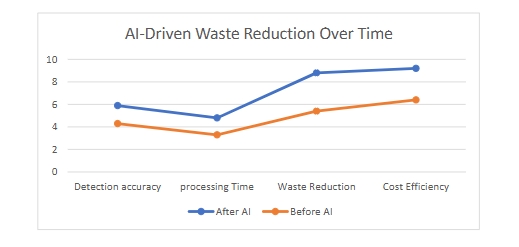
Growing consumer demands and intricate supply networks are making it more difficult for the global food industry to maintain high standards of quality and ensure food safety. Conventional inspection techniques sometimes take a lot of time, cause damage, and are inaccurate enough to miss contaminants or quality problems early. These drawbacks emphasize how sophisticated, effective, and non-invasive technology is required for food quality monitoring. This effort aims to investigate the use of Hyperspectral Imaging (HSI) in conjunction with Artificial Intelligence (AI) for food contamination inspection and prediction. Food's chemical and physical characteristics that are undetectable to the human eye can be revealed by hyperspectral imaging, which takes pictures at a variety of wavelengths. The findings show that AI-based HSI offers notable advantages over traditional techniques in terms of quick, accurate, and non-destructive examination. It makes early contamination detection possible and aids in preserving food quality throughout the supply chain. By reducing waste, guaranteeing product authenticity, and boosting customer trust in food items, our effort helps worldwide food safety and advance the development of smarter food inspection systems.
References
Abid, S. K., Sulaiman, N., Chan, S. W., Nazir, U., Abid, M., Han, H., Ariza-Montes, A., & Vega-Muñoz, A. (2021). Toward an Integrated Disaster Management Approach: How Artificial Intelligence Can Boost Disaster Management. Sustainability, 13(22), 12560. https://doi.org/10.3390/su132212560
Chen, L., Sun, D. W., & Zhao, Y. (2021). Non-Destructive Detection of Food Contamination Using Hyperspectral Imaging. Journal of Food Engineering, 285, 110139. https://doi.org/10.1016/j.jfoodeng.2020.110139
Dębska, B., & Guzowska-Świder, B. (2011). Application of Artificial Neural Network in Food Classification. Analytica Chimica Acta, 705(1–2), 283–291. https://doi.org/10.1016/j.aca.2011.06.033
Dewi, M. U., Santoso, L., & Santoso, A. B. (2024). Optimizing AI Performance in Industry: A Hybrid Computing Architecture Approach Based on Big Data. Journal of Technology Informatics and Engineering, 3(3), 321–336. https://doi.org/10.51903/jtie.v3i3.205
Donaghy, J. A., et al. (2021). Big Data Impacting Dynamic Food Safety Risk Management in the Food Chain. Frontiers in Microbiology, 12, 668196. https://doi.org/10.3389/fmicb.2021.668196
Dora, M., Kumar, A., Mangla, S. K., Pant, A., & Kamal, M. M. (2022). Critical Success Factors Influencing Artificial Intelligence Adoption in Food Supply Chains. International Journal of Production Research, 60(14), 4621–4640. https://doi.org/10.1080/00207543.2021.195966
Gowen, A. A., & O’Donnell, C. P. (2023). Hyperspectral Imaging and Machine Learning in Food Microbiology. Comprehensive Reviews in Food Science and Food Safety, 22(1), 123–145. https://doi.org/10.1111/1541-4337.12983
Gunasekaran, S. (1996). Computer Vision Technology for Food Quality Assurance. Trends in Food Science & Technology, 7(8), 245–256. https://doi.org/10.1016/0924-2244(96)10028-5
He, K., Zhang, X., Ren, S., & Sun, J. (2016). Deep Residual Learning for Image Recognition. Proceedings of the IEEE Conference on Computer Vision and Pattern Recognition. https://doi.org/10.1109/cvpr.2016.90
Jin, C., et al. (2020). Big Data in Food Safety—A Review. Current Opinion in Food Science, 36, 24–32. https://doi.org/10.1016/j.cofs.2020.01.005
Kotsanopoulos, K. V., & Arvanitoyannis, I. S. (2017). The Role of Auditing, Food Safety, and Food Quality Standards in the Food Industry. Comprehensive Reviews in Food Science and Food Safety, 16(5), 760–775. https://doi.org/10.1111/1541-4337.12293
Kumar, A., Patel, R., & Mehta, S. (2021). Hyperspectral Imaging and CNN-Based Analysis for Detection of Adulteration in Spices. Journal of Food Processing & Technology, 12(7), 314–321.
Li, P., Tang, S., Chen, S., Tian, X., & Zhong, N. (2023). Hyperspectral Imaging Combined With Convolutional Neural Network for Accurately Detecting Adulteration in Atlantic Salmon. Food Control, 147, 109573. https://doi.org/10.1016/j.foodcont.2023.109573
Liu, Y., Zhang, X., Li, J., & Wei, Y. (2021). A Deep Learning Approach to Hyperspectral Imaging for Food Contamination Detection. Sensors, 21(14), 4759. https://doi.org/10.3390/sensors21144759
Mangun, A. P., Nugroho, H., & Prasetyo, R. W. (2024). Big Data-Driven Edge Architecture to Support Real-Time Processing in AI-Based Inspection Systems. Journal of Technology Informatics and Engineering, 3(3), 350–362. https://doi.org/10.51903/jtie.v3i3.206
Nie, S., Gao, W., Liu, S., Li, M., Li, T., Ren, J., Ren, S., & Wang, J. (2024). Hyperspectral Imaging Combined With Deep Learning Models for the Prediction of Geographical Origin and Fungal Contamination in Millet. Frontiers in Sustainable Food Systems, 8, Article 1454020. https://doi.org/10.3389/fsufs.2024.1454020
Palakurti, N. R. (2022). AI Applications in Food Safety and Quality Control. ESP Journal of Engineering & Technology Advancements, 2(3), 48–61. https://doi.org/10.56472/25832646/jeta-v2i3p111
Priyadi, P., Migunani, M., & Sasmoko, D. (2024). Enhancing Big Data Processing Efficiency in AI-Based Healthcare Systems: A Comparative Analysis of Random Forest and Deep Learning. Journal of Technology Informatics and Engineering, 3(3), 263–278. https://doi.org/10.51903/jtie.v3i3.203
Seyedghorban, Z., Tahernejad, H., Meriton, R., & Graham, G. (2020). Supply Chain Digitalization: Past, Present and Future. Production Planning & Control, 31(2–3), 96–114. https://doi.org/10.1080/09537287.2019.1631461
Sharma, V., Singh, R., & Gupta, N. (2020). Application of Convolutional Neural Networks for Hyperspectral Imaging in Milk Adulteration Detection. Indian Journal of Dairy Science, 73(4), 255–262.
Sun, D. W., & Ma, J. (2022). Advances in Machine Learning and Hyperspectral Imaging in the Food Supply Chain. Food and Bioprocess Technology, 15(7), 1234–1250. https://doi.org/10.1007/s12393-022-09322-2
Susatyono, J. D., Suasana, I. S., & Rozikin, K. (2024). Integrating Big Data and Edge Computing for Enhancing AI Efficiency in Real-Time Applications. Journal of Technology Informatics and Engineering, 3(3), 337–349. https://doi.org/10.51903/jtie.v3i3.204
Taneja, A., et al. (2023). Artificial Intelligence: Implications for the Agri-Food Sector. Agronomy, 13, 1397. https://doi.org/10.3390/agronomy13061397
Wang, Z., Xu, Y., & Qian, X. (2020). Application of Convolutional Neural Networks in Hyperspectral Imaging for Food Quality Analysis. Food Control, 109, 106924. https://doi.org/10.1016/j.foodcont.2019.106924
Zhang, Y., Qin, J., & Chen, Y. (2020). Advances in Hyperspectral Imaging for Food Quality and Safety. Critical Reviews in Food Science and Nutrition, 60(11), 1823–1840. https://doi.org/10.1080/10408398.2018.1551160
Downloads
Published
Issue
Section
License
Copyright (c) 2025 Sudha. S, Sivaranjani Nafeeza

This work is licensed under a Creative Commons Attribution-ShareAlike 4.0 International License.