Optimization of Smart Home Energy Consumption Using Machine Learning-Based Load Forecasting
DOI:
https://doi.org/10.51903/jtie.v4i2.437Keywords:
Smart Home Energy Management, Load Forecasting, LSTM, Random Forest, Time Series PredictionAbstract
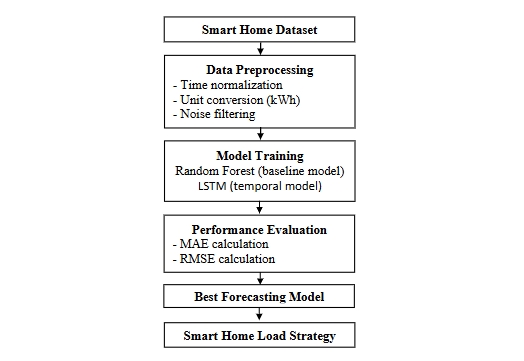
The growing demand for energy efficiency in smart homes necessitates accurate short-term load forecasting to enable adaptive scheduling and optimal resource allocation. Traditional forecasting models, such as Random Forest, have demonstrated limited capability in capturing sequential dependencies, especially under fluctuating consumption behaviors typical of residential environments. This study aims to compare the forecasting performance of RF and Long Short-Term Memory (LSTM) models in predicting household energy consumption, to identify the most suitable approach for intelligent energy management systems. A quantitative experimental design was adopted using a publicly available dataset, which underwent preprocessing including time normalization and unit conversion. Both models were evaluated using Mean Absolute Error (MAE) and Root Mean Square Error (RMSE) to assess forecasting accuracy. The LSTM model achieved a lower MAE of 3.2 and RMSE of 4.1, significantly outperforming the RF model, which recorded an MAE of 6.5 and RMSE of 8.4. Additionally, during peak load conditions, LSTM achieved 89.7% accuracy, compared to 72.4% for RF, further emphasizing its superior adaptability to time-sensitive variations. The results confirm that LSTM is more effective in modeling temporal patterns and handling volatility in household energy usage. This research contributes to the field by reinforcing the applicability of deep learning for real-time energy forecasting, offering valuable insights for the development of smart home systems. Future studies may expand this work by integrating hybrid optimization techniques and exploring multi-household scenarios for broader scalability.
References
Arévalo, P., Jurado, F., Arévalo, P., & Jurado, F. (2024). Impact of Artificial Intelligence on the Planning and Operation of Distributed Energy Systems in Smart Grids. Energies, 17(17), 4501. https://doi.org/10.3390/en17174501
Arman, A., Prasetya, P., Arifany, F. N., Pradnyaparamita, F. B., & Laksito, J. (2022). A Digital Printing Application as an Expression Identification System. Journal of Technology Informatics and Engineering, 1(2), 5–15. https://doi.org/10.51903/jtie.v1i2.135
Asiri, M. M., Aldehim, G., Alotaibi, F. A., Alnfiai, M. M., Assiri, M., & Mahmud, A. (2024). Short-Term Load Forecasting in Smart Grids Using Hybrid Deep Learning. IEEE Access, 12, 23504–23513. https://doi.org/10.1109/access.2024.3358182
Bielecki, A., & Dudek, G. (2022). A Comprehensive Study of Random Forest for Short-Term Load Forecasting. Energies, 15(20), 7547. https://doi.org/10.3390/en15207547
Chen, E. X., Han, X., Malkawi, A., Zhang, R., & Li, N. (2023). Adaptive Model Predictive Control with Ensembled Multi-Time Scale Deep-Learning Models for Smart Control of Natural Ventilation. Building and Environment, 242, 110519. https://doi.org/10.3390/buildings14113446
Chen, G., Chen, Y., Tan, X., Zhao, L., Cai, Y., & Li, L. (2023). Assessing the Urban Heat Island Effect of Different Local Climate Zones in Guangzhou, China. Building and Environment, 244, 110770. https://doi.org/10.1016/j.buildenv.2023.110770
Fayyazbakhsh, A., Kienberger, T., & Vopava-Wrienz, J. (2025). Comparative Analysis of Load Profile Forecasting: LSTM, SVR, and Ensemble Approaches for Singular and Cumulative Load Categories. Smart Cities, 8(2), 65. https://doi.org/10.3390/smartcities8020065
Forootani, A., Rastegar, M., & Sami, A. (2022). Short-Term Individual Residential Load Forecasting Using an Enhanced Machine Learning-Based Approach Based on a Feature Engineering Framework: A Comparative Study with Deep Learning Methods. Electric Power Systems Research, 210, 108119. https://doi.org/10.1016/j.epsr.2022.108119
Han, F., & Wang, X. (2023). Adaptive Individual Residential Load Forecasting Based on Deep Learning and Dynamic Mirror Descent. Frontiers in Energy Research, 10, 986146. https://doi.org/10.3389/fenrg.2022.986146
Ji, X., Huang, H., Chen, D., Yin, K., Zuo, Y., Chen, Z., & Bai, R. (2022). A Hybrid Residential Short-Term Load Forecasting Method Using Attention Mechanism and Deep Learning. Buildings, 13(1), 72. https://doi.org/10.3390/buildings13010072
Khan, S., Mazhar, T., Khan, M. A., Shahzad, T., Ahmad, W., Bibi, A., Saeed, M. M., & Hamam, H. (2024). Comparative Analysis of Deep Neural Network Architectures for Renewable Energy Forecasting: Enhancing Accuracy with Meteorological and Time-Based Features. Discover Sustainability, 5(1), 1–24. https://doi.org/10.1007/s43621-024-00783-5
Lei, X., Lin, Y., Yang, Q., Zhou, J., Chen, X., & Wen, J. (2022). Research on Coordinated Control of Renewable-Energy-Based Heat-Power Station System. Applied Energy, 324, 119736. https://doi.org/10.1016/j.apenergy.2022.119736
Mu, Y., Wang, M., Zheng, X., & Gao, H. (2023). An Improved LSTM-Seq2Seq-Based Forecasting Method for Electricity Load. Frontiers in Energy Research, 10, 1093667. https://doi.org/10.3389/fenrg.2022.1093667
Poyyamozhi, M., Murugesan, B., Rajamanickam, N., Shorfuzzaman, M., & Aboelmagd, Y. (2024). IoT—A Promising Solution to Energy Management in Smart Buildings: A Systematic Review, Applications, Barriers, and Future Scope. Buildings, 14(11), 3446. https://doi.org/10.3390/buildings14113446
Putra, T. W. A., Setiawan, N. D., & Rusito, R. (2024). The Use of Machine Learning for Efficient Energy Management in Big Data-Based Computing Systems. Journal of Technology Informatics and Engineering, 3(3), 324–336. https://doi.org/10.51903/jtie.v3i3.202
Rodriguez, M., Arcos–Aviles, D., & Martinez, W. (2023). Fuzzy Logic-Based Energy Management for Isolated Microgrid Using Meta-Heuristic Optimization Algorithms. Applied Energy, 335, 120771. https://doi.org/10.1016/j.apenergy.2023.120771
Santoso, J. T., Wibowo, A., & Raharjo, B. (2024). Enhancement of Internal Business Process Using Artificial Intelligence. Jurnal Nasional Pendidikan Teknik Informatika: JANAPATI, 13(3), 612–620. https://doi.org/10.23887/janapati.v13i3.79242
Santoso, L., & Priyadi. (2024). Comparative Study of Feature Engineering Techniques for Predictive Data Analytics. Journal of Technology Informatics and Engineering, 3(2), 417–435. https://doi.org/10.51903/jtie.v3i2.225
Smyl, S., Dudek, G., & Pełka, P. (2024). Contextually Enhanced ES-dRNN with Dynamic Attention for Short-Term Load Forecasting. Neural Networks, 169, 660–672. https://doi.org/10.1016/j.neunet.2023.11.017
Tran, Q. T., Roose, L., Doan Van, B., & Nguyen, Q. N. (2022). A Low-Cost Online Health Assessment System for Oil-Immersed Service Transformers Using Real-Time Grid Energy Monitoring. Energies, 15(16), 5932. https://doi.org/10.3390/en15165932
Wang, Y., Jiang, W., Wang, C., Song, Q., Zhang, T., Dong, Q., & Li, X. (2023). An Electricity Load Forecasting Model Based on Multilayer Dilated LSTM Network and Attention Mechanism. Frontiers in Energy Research, 11, 1116465. https://doi.org/10.3389/fenrg.2023.1116465
Xiang, Y., Guo, Y., Wu, G., Liu, J., Sun, W., Lei, Y., & Zeng, P. (2022). Low-Carbon Economic Planning of Integrated Electricity-Gas Energy Systems. Energy, 249, 123755. https://doi.org/10.1016/j.energy.2022.123755
Xiao, Y., Jin, X., Pan, T., Yu, Z., & Ding, L. (2025). A Federated Learning Algorithm That Combines DCScaffold and Differential Privacy for Load Prediction. Energies, 18(6), 1482. https://doi.org/10.3390/en18061482
Yan, C., & Qiu, Z. (2025). Review of Power Market Optimization Strategies Based on Industrial Load Flexibility. Energies, 18(7), 1569. https://doi.org/10.3390/en18071569
Yunita, A., Pratama, I., Almuzakki, M. Z., Ramadhan, H., Patah Akhir, E. A., Firdausiah Mansur, A. B., & Basori, A. H. (2025). Performance Analysis of Neural Network Architectures for Time Series Forecasting: A Comparative Study of RNN, LSTM, GRU, and Hybrid Models. MethodsX, 103462. https://doi.org/10.1016/j.mex.2025.103462
Downloads
Published
Issue
Section
License
Copyright (c) 2025 Arif Rifan Rudiyanto, Bagas Panji Satria, Haposan Daniel Panjaitan

This work is licensed under a Creative Commons Attribution-ShareAlike 4.0 International License.